| |
Stories from
Our Back Pages
Shabbona & Black Hawk
DeKalb County Courthouse
Underground Railroad
The First Woman Sheriff
Indian Creek Massacre
How NIU Came to DeKalb
The Canadian Connection
Testimony of an ex-slave
Fish Kills on the Kishwaukee
Local History
Resources
Regional History Center at NIU
Joiner History Room
Ellwood House Museum
Gurler House
Stone Mill Museum
Egyptian Theatre
Sandwich Opera House
Olmstead Museum
DeKalb Heritage Square
DeK County Gen Web
Sycamore History Association
|
|
|
|
| DeKalb County History |
|
The Underground Railroad in Sycamore
by Mac McIntyre
copyright© 1998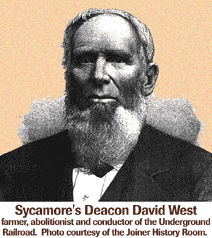
A lone man lurked about the corn field just outside of the town of Sycamore. He was a black man. He had trekked a long and treacherous journey from deep within the South on his way, hopefully, to freedom that was only available, for him, in Canada.
He started out from a plantation in Georgia. He had been taught from the lessons of Harriet Tubman: Travel at night. Sleep cautiously during the day. Follow the "big drinking gourd" (Big Dipper) on his way to the north. Watch for signs, such as a drinking gourd placed on the front doors of white people's homes, as this indicated someone willing to help with at least a little food and possibly some shelter. Look for quilts hanging on the laundry lines of "friendlies" that were patterned in secret codes informing of impending danger or safety. Don't get caught and, if you do, do not tell where you've been or who helped you get there.
From Georgia, the man traveled west. Ever since the "Fugitive Slave Act" was passed in 1850, rewards were being offered for catching runaway slaves and turning in those who would help them escape. Tennessee, Kentucky and most of Illinois were no longer safe to travel. By going west he could hope to connect with the Underground Railroad, a clandestine operation conducted by those with abolitionist views. In Kansas was the "Brown Line," an organization led by the militant John Brown. From there it was on to Iowa to hook up with the "Lovejoy Line," headed up by Owen Lovejoy from Princeton, Illinois. Owen's brother, Elijah, had been assassinated in Alton for publishing an abolitionist newspaper.
Owen Lovejoy had organized an extensive network through northern Illinois. As a deacon in the Congregational Church he established many contacts with members of associate churches from the Mississippi River to the shores of Lake Michigan. One such member, David West, resided just east of Sycamore. Although not as militant as John Brown, nor as vocal as Owen Lovejoy, David West was very firm in his anti-slavery beliefs.
West had a reputation of being a "conductor" on the Underground Railroad. He was also known for his adroit shooting ability. It was said he could "shoot the eye out of a deer from 50 yards away." This reputation served him well on at least one occasion when a local sheriff and a couple bounty hunters contemplated stopping his wagon and searching it for runaway slaves. The reward they were after was more than $1,000, big money in those days. When they heard about his shooting ability and saw the confidence in which he carried about on his mission the sheriff and the bounty hunters decided that lives were more valuable than the $1,000.
It was people like Lovejoy and West who, despite great risk to themselves, helped to bring the barbaric practice of slavery to an end in the United States. The name of Lovejoy is better known than that of West. After all, he had lost a brother to the cause when Elijah was gunned down. West took many risks but perhaps those risks were lessened somewhat because there were so many in Sycamore who actively participated in helping others reach freedom.
There were the Kelloggs, the Pages, the Townsends and the Nickersons who were known members of the Underground Railroad. There were others. The First Congregationalist Church in Sycamore held meetings and officially passed, as policy, a proclamation that encouraged their members to assist in the efforts of the Underground Railroad. The building that was the home of the Universalist Church at that time, a stately residence even today, may have been used as a station, that is debated, but certainly the church assisted in the effort.
There were more than 40 Sycamore residents who were registered at the post office as subscribers to abolitionists newspapers. The sentiment against slavery was so strong in Sycamore that the newly forming Republican Party thought it best to hold one of its earliest meetings there.
Stephen Douglas, the Democrat and proponent of state's rights -- even if those rights included not allowing all humans the basic right of freedom -- came to Sycamore to try to undo what was done with the meetings of the early Republicans. His visit and speech were lightly attended. When Frederick Douglas, the slave who became a free man, spoke in Sycamore, large crowds attended.
If the runaway slave reached Sycamore, he or she would have greatly increased the chances for obtaining the elusive right of freedom. With a day or two stay and some much needed nourishment, the runaway was off to St. Charles, Chicago, Lake Michigan and Canada.
The story of the Underground Railroad is a segment of Sycamore's history that should be remembered. Because of its clandestine nature, however, the whole story may never be told.
|
|
|
|
|